Loneliness in Australia: 2026 Statistics and Key Facts
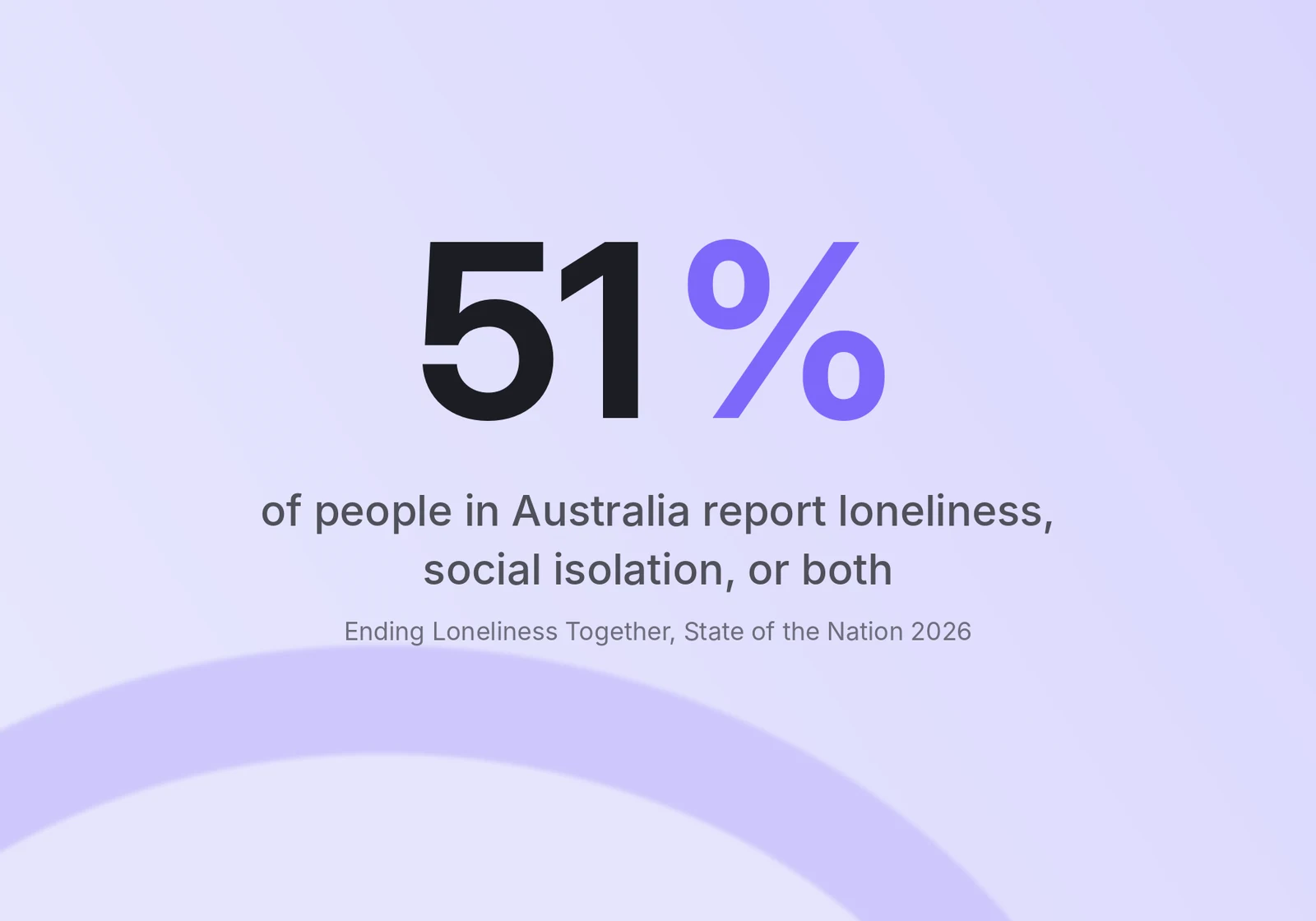
More than half of people in Australia (51%) report some form of social disconnection in 2026. They are lonely, socially isolated, or both.
Those figures come from Ending Loneliness Together's State of the Nation 2026 report, a nationally representative survey of 4,001 people aged 12 to 95. This page collects the most reliable current numbers on loneliness in Australia in one place, with a link to every source. Last updated: October 2026.
Key numbers at a glance
- 51% of people in Australia report social disconnection: loneliness, social isolation, or both.
- 28% are lonely, and 16% are severely lonely.
- 42% are socially isolated.
- 19% are both lonely and socially isolated.
- 43% of young Australians aged 15 to 25 are lonely.
- People in regional and remote areas are 1.3 times as likely as city residents to be both lonely and isolated.
- Loneliness costs Australia up to $2.7 billion a year in health-related costs.
- One in four Australian households (25.6%) is a person living alone.
Sources for each figure are in the sections below.
Loneliness and social isolation are different things
Loneliness is a feeling: the distress of wanting more or better connection than you have. Social isolation is a count: few relationships and little contact with other people. You can be isolated without feeling lonely, and you can feel lonely in a full house.
The 2026 report measures both. It uses the four-item UCLA Loneliness Scale for loneliness and the Lubben Social Network Scale for isolation.
How many Australians are lonely in 2026?
| Group | Share of people in Australia |
|---|---|
| Lonely only | 9% |
| Socially isolated only | 23% |
| Both lonely and socially isolated | 19% |
| Neither | 49% |
Add the groups together and 28% of people are lonely and 42% are socially isolated. The 16% who are severely lonely sit inside that 28%.
The survey ran in January and February 2026 and was weighted by age, gender and region. Source: State of the Nation 2026, Ending Loneliness Together with the University of Sydney and Wallis Social Research.
Who is most affected?
Age
Loneliness on its own peaks in young adults. Among people aged 18 to 25, 18% are lonely without being isolated, the highest of any age group.
Midlife carries the heaviest combined load. Among people aged 45 to 54, 28% are both lonely and isolated, and another 27% are isolated only. Among people aged 65 to 74, 27% are isolated without reporting loneliness.
The pattern cuts against the picture of loneliness as mainly an old-age problem.
Gender
There is no gender gap. 19% of women and 19% of men are both lonely and socially isolated.
Where you live
In regional and remote areas, 23% of people are both lonely and isolated, compared with 17% in urban areas.
| State or territory | Both lonely and socially isolated |
|---|---|
| South Australia | 22% |
| Australian Capital Territory | 22% |
| Western Australia | 21% |
| Tasmania | 21% |
| Queensland | 19% |
| New South Wales | 18% |
| Victoria | 18% |
| Northern Territory | 13% |
The report found the differences between states were not statistically significant. No state can fairly be called the loneliest.
Who you live with
| Living arrangement | Both lonely and socially isolated |
|---|---|
| Shared accommodation | 29% |
| Living alone | 27% |
| With family | 16% |
| With a partner | 15% |
Having people in the house is no guarantee. Shared accommodation, which here includes colleges and residential homes, has the highest rate.
Relationship status
26% of people who are separated, divorced or widowed are both lonely and isolated, compared with 23% of single people and 15% of partnered people.
Health
25% of people living with a chronic illness are both lonely and isolated, compared with 12% of people without one.
Of people who are both lonely and isolated, 60% meet the screening cut-off for depression and 57% for social anxiety. These are screening scores, not diagnoses, and a one-off survey cannot say which came first.
Loneliness among young Australians
43% of Australians aged 15 to 25 are lonely, according to A Call for Connection, published in August 2025 by Ending Loneliness Together and the University of Sydney. It followed 1,085 young people across the 2022 and 2023 waves of the HILDA survey.
- 28% were lonely at one of the two annual survey points.
- 15%, about one in seven, were lonely at both. The report calls this persistent loneliness.
- Persistent loneliness was more common at ages 18 to 25 (17.8%) than at 15 to 17 (10.8%).
- Young people who were not active members of a sporting, hobby or community club had 1.45 times the odds of persistent loneliness.
Is loneliness in Australia getting worse?
Not clearly. The 2023 Ending Loneliness Together survey of adults found 32% lonely and 46% socially isolated. The 2026 figures are 28% and 42%, but the 2026 survey also includes people aged 12 to 17. The 2026 report's own reading is that prevalence has not meaningfully changed.
The longer-running HILDA survey, reported by the Australian Institute of Health and Welfare, shows a pandemic spike that has only partly unwound:
- Social isolation among people aged 15 and over was 13% in 2019, 16% in 2021 and 15% in 2024.
- Among people aged 15 to 24 it was 12% in 2019, 22% in 2021 and 17% in 2024.
- Loneliness among people aged 65 and over fell from 20% in 2001 to 15% in 2024.
Why do different surveys give different numbers?
Because they ask different questions and draw the line in different places. The figures below are all correct and none can be compared with another.
| Source | Year | Headline figure | Who was surveyed |
|---|---|---|---|
| Ending Loneliness Together, State of the Nation | 2026 | 28% lonely | Ages 12 to 95 |
| AIHW, using HILDA | 2024 | 15% lonely | Ages 15 and over |
| A Call for Connection | 2025 | 43% lonely | Ages 15 to 25 |
| Swinburne and Australian Psychological Society | 2018 | About one in four lonely | Adults |
The often-quoted "one in four" comes from the 2018 Swinburne study. It is not a current figure.
What loneliness does to health
A 2015 review of the research by Julianne Holt-Lunstad and colleagues found a higher likelihood of early death of 29% for social isolation, 26% for loneliness and 32% for living alone.
The World Health Organization's Commission on Social Connection reported in June 2025 that loneliness affects about one in six people worldwide and is linked to more than 871,000 deaths a year, around 100 every hour.
Is loneliness really as bad as smoking 15 cigarettes a day?
That line overstates the research. It traces to a 2010 review of 148 studies covering 308,849 people, which found that people with stronger social relationships had a 50% greater likelihood of survival. The authors compared the size of that effect with other risk factors, including smoking fewer than 15 cigarettes a day. The finding was about social relationships broadly, not loneliness specifically.
What loneliness costs Australia
Loneliness costs up to $2.7 billion a year in health-related costs, or about $1,565 for each person who becomes lonely, according to Stronger Together, a 2021 report from the Bankwest Curtin Economics Centre.
What the data says helps
The 2026 State of the Nation report tested which everyday habits go with lower odds of being both lonely and socially isolated, after adjusting for people's backgrounds.
| Habit | Lower odds of being both lonely and isolated |
|---|---|
| Spending 1 to 3 hours a week with friends, compared with none | 90% |
| Having one or two close friends, compared with none | 89% |
| Regularly attending community events | 89% |
| Regularly chatting with neighbours | 88% |
| Regularly volunteering, formally or informally | 62% |
A stronger sense of community was also linked to lower odds.
Read these with care. They are associations from a single survey. They show what connected people have in common, not proof that any one habit prevents loneliness. Even so, the bar is low: one or two close friends, and an hour or more a week together.
Getting there takes time. University of Kansas research estimated roughly 50 hours together to move from acquaintance to casual friend, 90 hours to become friends and more than 200 hours to become close friends.
That is the thinking behind Bunchups: small, regular, in-person catch-ups with one or a few people who share an interest. For practical starting points, see our guides to making friends in Melbourne and Geelong, asking someone to hang out as friends and making friends as an adult in Australia.
How many Australians live alone?
25.6% of Australian households were one person living alone at the 2021 Census. The Australian Bureau of Statistics projects that between 3.4 and 4.0 million people will live alone by 2046.
Living alone is not the same as being lonely, though the living arrangement table above shows the two overlap.
Why people do not talk about it
In Ending Loneliness Together's 2023 survey of 4,026 adults, 49% said they would conceal feeling lonely, 31% said they feel ashamed when they are lonely, and 58% said they do not talk to others about it when they feel that way.
If you are feeling lonely right now
You are in very large company, and talking to someone helps. These services are free and open 24 hours a day.
| Service | Phone | For |
|---|---|---|
| Lifeline | 13 11 14 | Anyone in distress |
| Beyond Blue | 1300 22 4636 | Anxiety, depression and loneliness |
| Kids Helpline | 1800 55 1800 | Ages 5 to 25 |
| 13YARN | 13 92 76 | Aboriginal and Torres Strait Islander people |
| MensLine Australia | 1300 78 99 78 | Men |
In an emergency, call 000.
Frequently asked questions
How many Australians are lonely?
28% of people in Australia are lonely, according to the 2026 State of the Nation report. Counting social isolation as well, 51% report some form of social disconnection.
Which age group is the loneliest in Australia?
It depends on the measure. People aged 18 to 25 have the highest rate of loneliness on its own (18%). People aged 45 to 54 have the highest rate of being both lonely and socially isolated (28%).
Which state is the loneliest in Australia?
No state stands out. Rates of being both lonely and isolated range from 13% in the Northern Territory to 22% in South Australia and the ACT, but the differences were not statistically significant.
Is loneliness increasing in Australia?
Not clearly. The 2026 report says prevalence has not meaningfully changed since 2023. HILDA data shows social isolation rose during the pandemic and has only partly come back down, especially for people aged 15 to 24.
What is the difference between loneliness and social isolation?
Loneliness is the feeling of lacking connection. Social isolation is having few relationships and little contact. In 2026, 9% of people were lonely only, 23% were isolated only and 19% were both.
How much does loneliness cost Australia?
Up to $2.7 billion a year in health-related costs, according to the Bankwest Curtin Economics Centre's 2021 estimate.
When is Loneliness Awareness Week in Australia?
Loneliness Awareness Week ran from 3 to 9 August in 2026, with the theme Make Room for Connection.
About this page
Bunchups compiled this page from the published reports linked above. We did not run the surveys, and figures are quoted as the source reports print them. We update the page when new national data is released. If you quote a figure, please cite the original report.


